Less manual data entry, automated processes, precise and multi-dimensional management reports. The system does not merely report the results of past periods – it projects the changes of the period ahead and makes them plannable. The future instead of the past, with the latest technological innovations.
DataMagic NextGEN ERP is built from clearly delimited sets of functions, but certain capabilities follow from the architecture and apply to every module. These are what give an integrated system its real potential.
Every module of the integrated system works from a single set of master data: a partner, an item and a document are recorded once, and stay the same everywhere from transport to the general ledger.
In a corporate group, different rule sets and permissions can be set per member company, while the identical data structure still yields consolidated statements and reports.

The company's business processes can be arranged into a chain: every document has a predecessor and a continuation. Data is entered once, the next step inherits the properties of the previous one, and the general-ledger entry is created from the same chain.
From any general-ledger entry the whole document chain can be traced back, all the way to the original request.

The permission matrix is a detailed control system: it can be defined exactly which user reaches which data as a reader or as an editor. Access can be set at field, document, window and module level alike, with role-based groups or individual rules.
Permissions can be delegated temporarily: for a holiday, a colleague's access can be widened for a defined period, with every step logged.

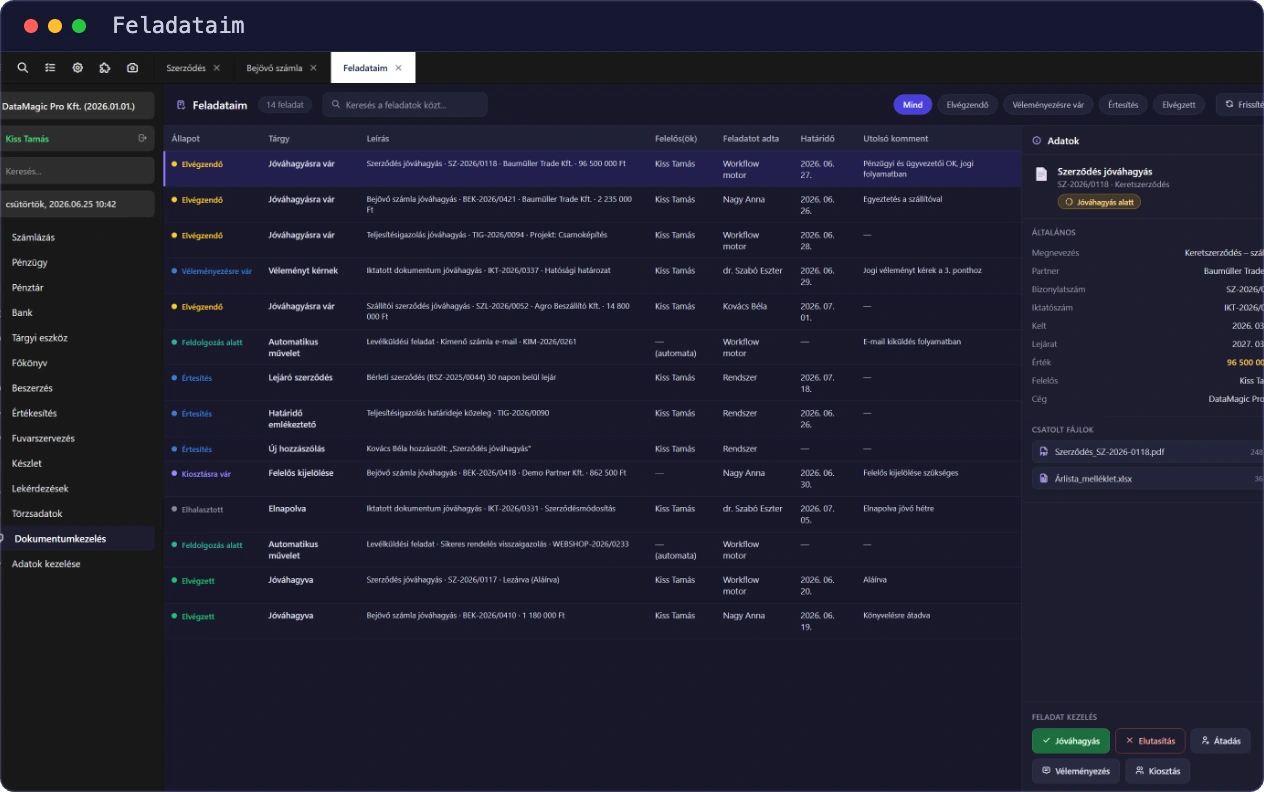
Process control methods can be built into the system: approval levels, value-threshold monitoring, or automation for any process that can be expressed as an algorithm.
The workflow engine is also capable of complex, multi-stage rule sets. Every process is logged individually, so the result of each run can be traced.

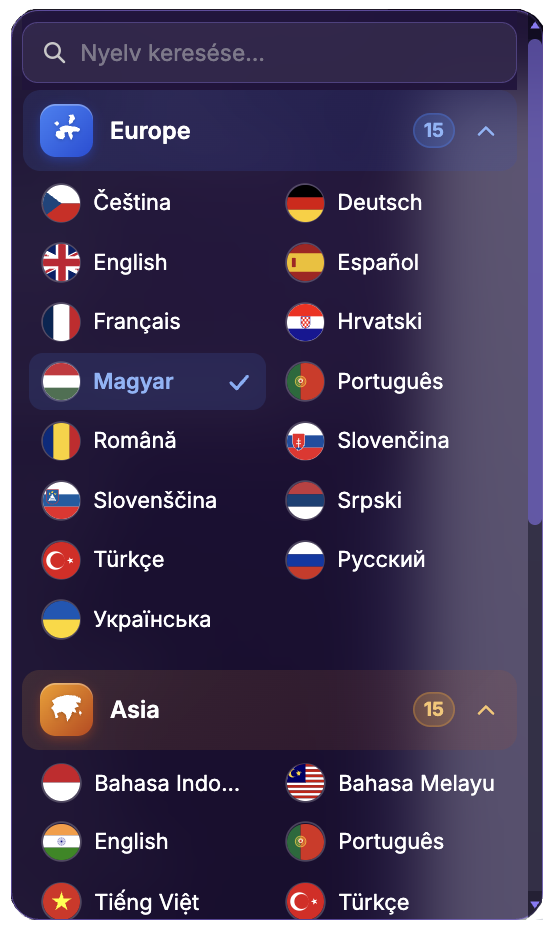
The language of the program can be set per user. The interfaces are available by default in every widely used international and European language, and can be configured quickly for any further language.
In an international group this eases daily work: one shared system, with each member company working in its own language.

The AI-based agent is a native part of the system, and its uses are wide: data analysis, report building or carrying out specific tasks.
It files a document, sends an e-mail or assembles a report, right where the user is working. On-premise and cloud models together: company data does not leave the network.

The ERP works entirely in the browser, yet there are cases where a separate purpose-built interface makes sense: reduced functionality or a simplified user interface for one particular task.
Thanks to the open REST API we also give access to the system's data through a custom web interface: a surface for entering and retrieving data can be built along any company-specific logic.

The discipline modules are built on the same permission model and business event chain, with shared partner, item and document master data. A rollout can proceed step by step while the system stays one.
TMSFrom the shipment order through route planning, the driver app and telematics to the cost price.
Details
WMSSeveral sites, dynamic location codes, batch, lot and serial numbers, data-capture processes.
Details
FMSInvoicing, receivables, banking and cash, fixed assets, tax-authority reporting, general ledger and statements.
Details
CRMA 360-degree partner record, sales pipeline, quotations and contracts, official partner risk control.
Details
DMSFiling, versioning, OCR, permissions and approval, tied to the document and the partner.
Details
AMSAthletes, sections, membership fees, subsidies and settlements together with the financial layer.
DetailsAn off-the-shelf system is quick to roll out but rigid; a fully bespoke one is flexible but expensive. The value lies where a configurable core meets plugin-based customisation.
Quick to roll out, but it hits a wall as soon as processes differ from the predefined logic.
A strong core that can be tailored to industry needs. Differentiating processes are built on top in a separate plugin, without touching the core.
Maximum freedom, but expensive, slow and a serious maintenance burden.
Most enterprise management rollouts fall short of their stated goal. The DataMagic success rate comes from the configurable core, plugin-based customisation and a project team that sees the rollout through.
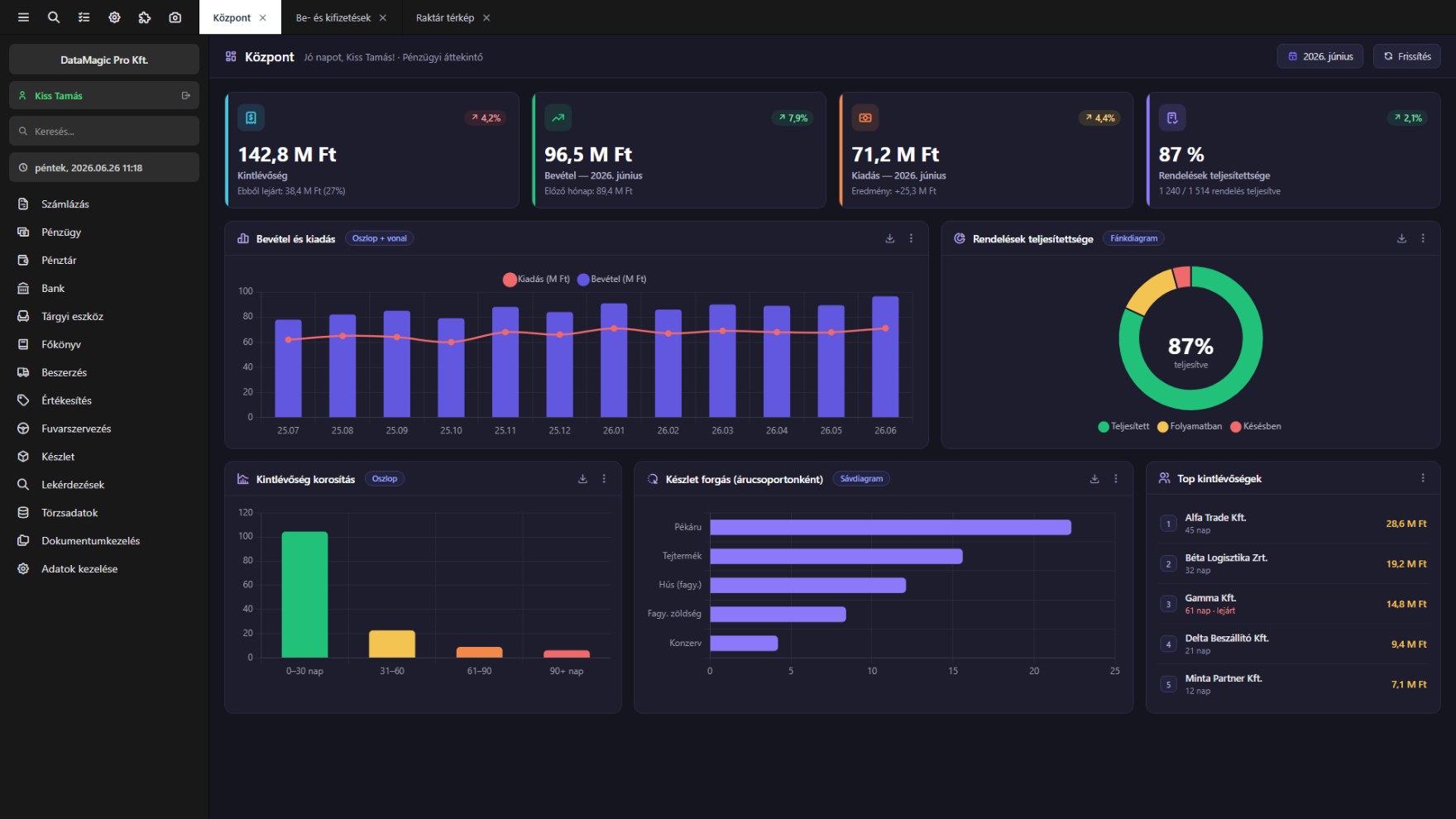
A traditional ERP is an administrative interface: it records, stores and reports. DataMagic NextGEN turns the recorded data into action – planning, automation and workflows alert, advance, delegate and obtain approvals with no or minimal human intervention.
It forecasts how cashflow is expected to develop – decisions are based on a current forecast rather than on hindsight.
The built-in workflow actively regulates and drives processes: every step takes place with the designated user and at the right time.
Built-in AI agents support decisions – with analysis, recommendations and automation, as an integral part of the system.
Prediction instead of administration – planning, process control and native AI on a single platform.
63+ modules, two-way banking and NAV (tax authority) connection, open REST API, built-in business intelligence — everything a Hungarian mid-sized or large company relies on day to day.
Full multi-currency financial and accounting functionality: posting modules to the general ledger, bank statement import / export / interface, NAV online invoicing, VAT and other tax filings, fixed-asset register, financial statement preparation.
Multiple sites, many warehouses, dynamic bin locations, batch, LOT, serial and assortment handling, every possible stock movement, dynamic stock valuation with any method.
Recipes, production orders, machine load, material usage, operation settlement.
Approval processes, automated actions, notifications.
Live dashboards, drill-down reports, Grafana and Excel exports.
Filing, attachments, folders, permissions, versioning, OCR processing.
The real ERP interface — economic event chain, visual workflow editor, configurable report builder, all on the same database.
Full supplier and customer chain, from request to financial statement: purchase request, quotation, price comparison, (framework) contract, order, goods-receipt / delivery note, invoice, bank / cash / other payment methods, general ledger — every document in one chain, with its relationships.
Approval steps, automations, branches — drag & drop process building without development.
Configurable reports, live charts, XLS/PDF/CSV/HTML exports — decision support in real time.
A short look at the interface and how it works — the user experience as it appears day to day.
DataMagic NextGEN is built on our own platform, refined over many years. This lets us map a mid-sized or large company's custom processes as plugins, without touching the core — keeping the system up to date for every client.
ERP development is a spectrum. An off-the-shelf system can be deployed quickly but is rigid; a fully bespoke one is flexible but costly and maintenance-intensive. The real value lies where a configurable core meets bespoke customisation.
It can be deployed quickly but soon hits a wall when processes deviate from the predefined logic.
A strong core that can be tailored to industry needs. A stable foundation on which differentiating processes are built individually and at lower risk.
Maximum freedom, but expensive and time-consuming, with a considerable maintenance burden.
According to international analyses, 55–75% of enterprise management implementations fail to reach their intended goals. DataMagic's outstanding success rate is due to its highly configurable core system, bespoke development tailored to client needs, and an experienced project team.
The permission matrix defines user rights at field level, and permission groups can also be created for easier management.
The visibility and editability of even a single data field can be controlled separately.
Role-based groups for fast, transparent assignment.
Permission levels apply at data field, document, window and module level alike.
Permissions can be transferred temporarily, with full logging; when the time window expires, the levels are automatically restored.
DataMagic NextGEN ERP natively integrates artificial intelligence into business processes. The AI functions are built on the framework's permission, audit and document models – the recognised data flows directly into the appropriate document, shipment, warehouse or financial record.
It runs on the company's internal server and accesses the entire corporate data asset through the ERP: it queries, records and navigates. The company's data never leaves the corporate network, not even for a moment.
It works with the most advanced language models available on the internet and gathers context from external data sources – market benchmarks, regulatory updates, document interpretation.
Trained on the company, RAG-based AI assistant available on every ERP screen: it understands where the user is and can also initiate operations. In natural language, you can request a report, open a new shipment order, or receive professional advice – VAT rate, account coding, storage zone – complete with references.
DataMagic ERP is open: it connects to business partners, official systems and devices through standard and custom interfaces.
EDI – electronic data interchange with business partners. EKÁER – monitoring of road freight traffic with automatic data reporting. Webshop connection – receiving online orders and writing back stock levels. Own API and synchronisation – custom interfaces with external partners.
Data collector (handheld terminal) – barcode-based mobile processes across the entire warehouse. Sensor connections – integration of environmental and process sensors. Cash register integration, label printer connections and scale communication with automatic weight readout.


From needs assessment to rollout, one team — a dedicated project manager and a technical architect who stays with you throughout.
An informal in-person or phone conversation where we uncover the organisation's current core problems and assess whether DataMagic can be the solution.
We present the general structure and operating logic of DataMagic ERP, live.
We model the company's internal operations, broken down into functions, economic event chains and workflows.
A detailed, transparent quote — broken down into fixed and optional items.
Detailed assessment, consulting and, where needed, process optimisation based on the DataMagic consulting team's prior experience (best practice) — breaking the company's internal operations into functions, economic event chains and workflows, we design the ERP that will support the future operation.
We implement company-specific logic primarily as plugins, without touching the core processes — but the framework itself can also be extended if needed.
Up-to-date support, legal and technological tracking during operation — new needs are delivered on short notice.

Download the DataMagic NextGEN ERP e-book for detailed information.
Have an informal chat with us about your questions regarding your enterprise management system — in a consultation we assess your processes and explore how DataMagic NextGEN ERP can fit your operation.
Request a consultation