The path of a document

A business event chain that reaches the general ledger

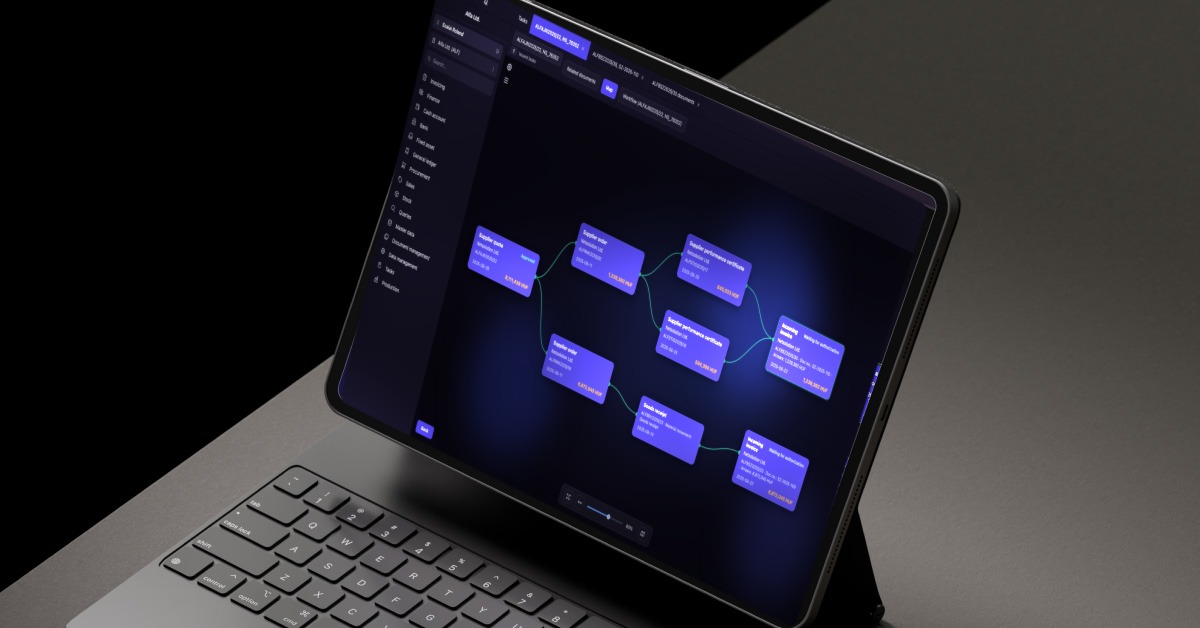
Bookkeeping is not retrospective data entry but the closing of operations. The same record travels through the system from the initial request to the financial statement, so every general-ledger entry can be traced back to the document it came from.

One record, one chain

An order becomes an invoice, the invoice becomes a settlement, the settlement becomes a general-ledger entry – each from its own predecessor.

Drill-down documents

From any general-ledger entry back to its predecessor along the document chain, all the way to the original file.

Data entered only once

Data is inherited between the steps of the chain: partner, item and terms travel from the order to the general-ledger posting without being re-entered.

The DataMagic business event chain: request, quotation, framework contract, order, delivery note, invoice, settlement, general-ledger posting and financial statement in one chain
Invoicing

Outgoing and incoming invoices in one document chain

Every invoice type works on the same principle: it has a predecessor and a continuation. A customer order becomes an invoice, an incoming invoice becomes a goods receipt, a proforma becomes an advance invoice.

Receivables management

Receivables handled where they arise

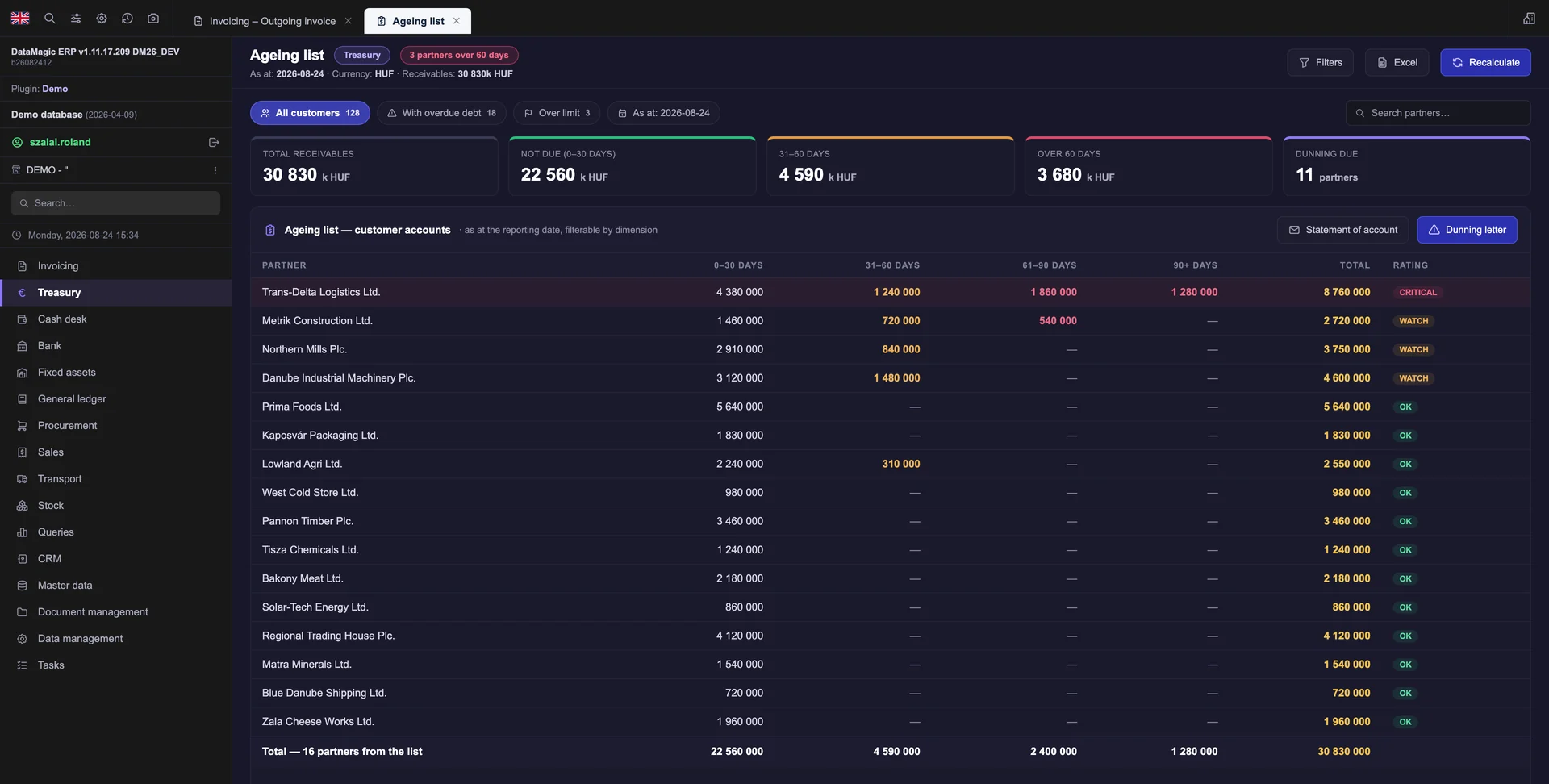
The ageing list is not a month-end report: the balance and any overdue debt are visible on the partner record and when a quotation is entered. Reminders and statements start from here.

Finance – Ageing list
DataMagic FMS ageing list: receivables per partner in 0–30, 31–60, 61–90 and 90+ day buckets with risk rating
Banking and cash

Bank data imported, with self-learning matching

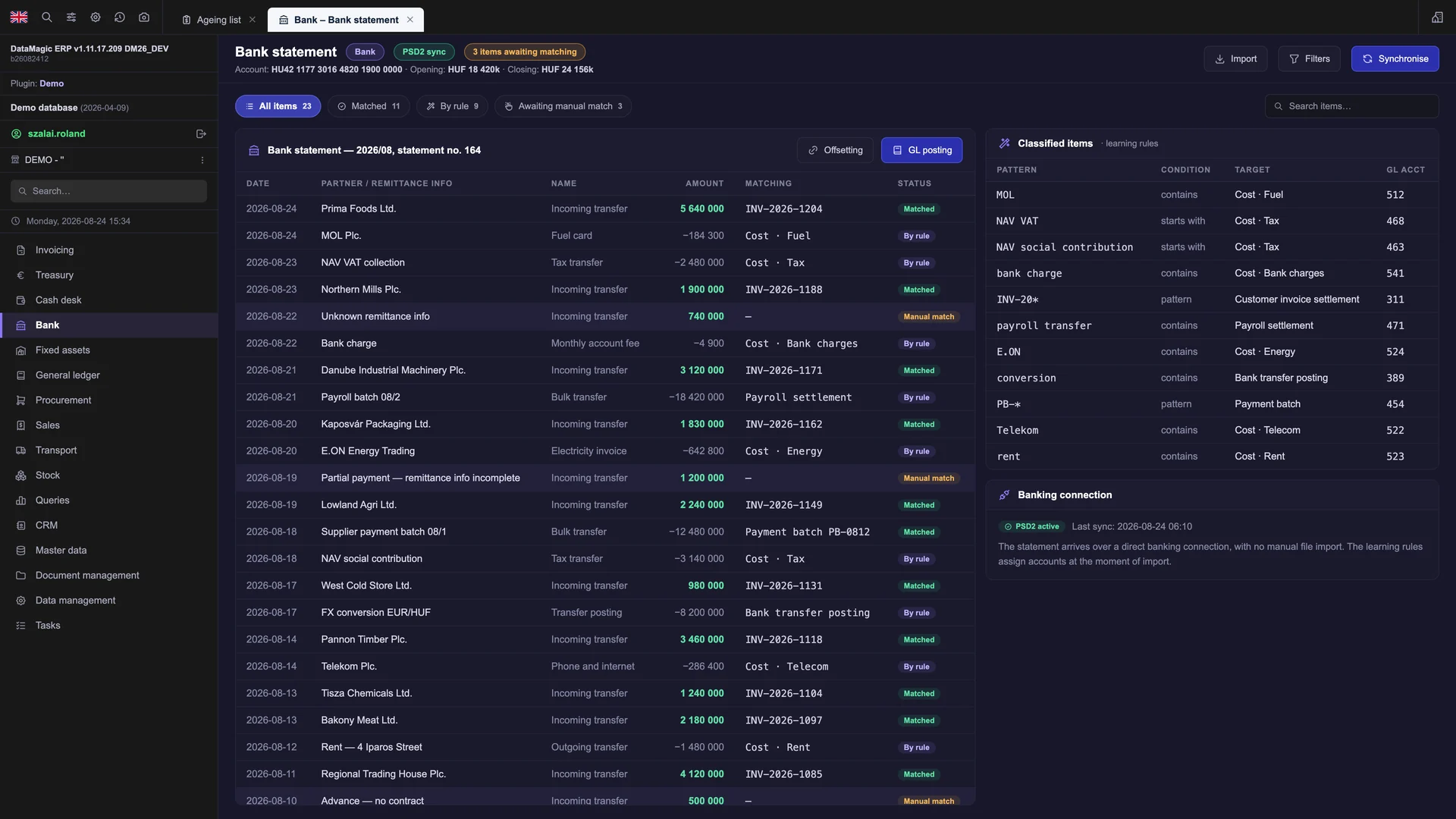
Statements arrive over a direct bank connection, with no manual file import. Rules for typed items post the entries at the moment of import, so a customer payment reaches the invoice and a cost reaches its general-ledger account.

Banking – Bank statement and learning rules
DataMagic FMS bank statement: bank entries imported over a PSD2 connection with automatic matching and self-learning rules
Accounting and bookkeeping

A general ledger fed automatically by the modules

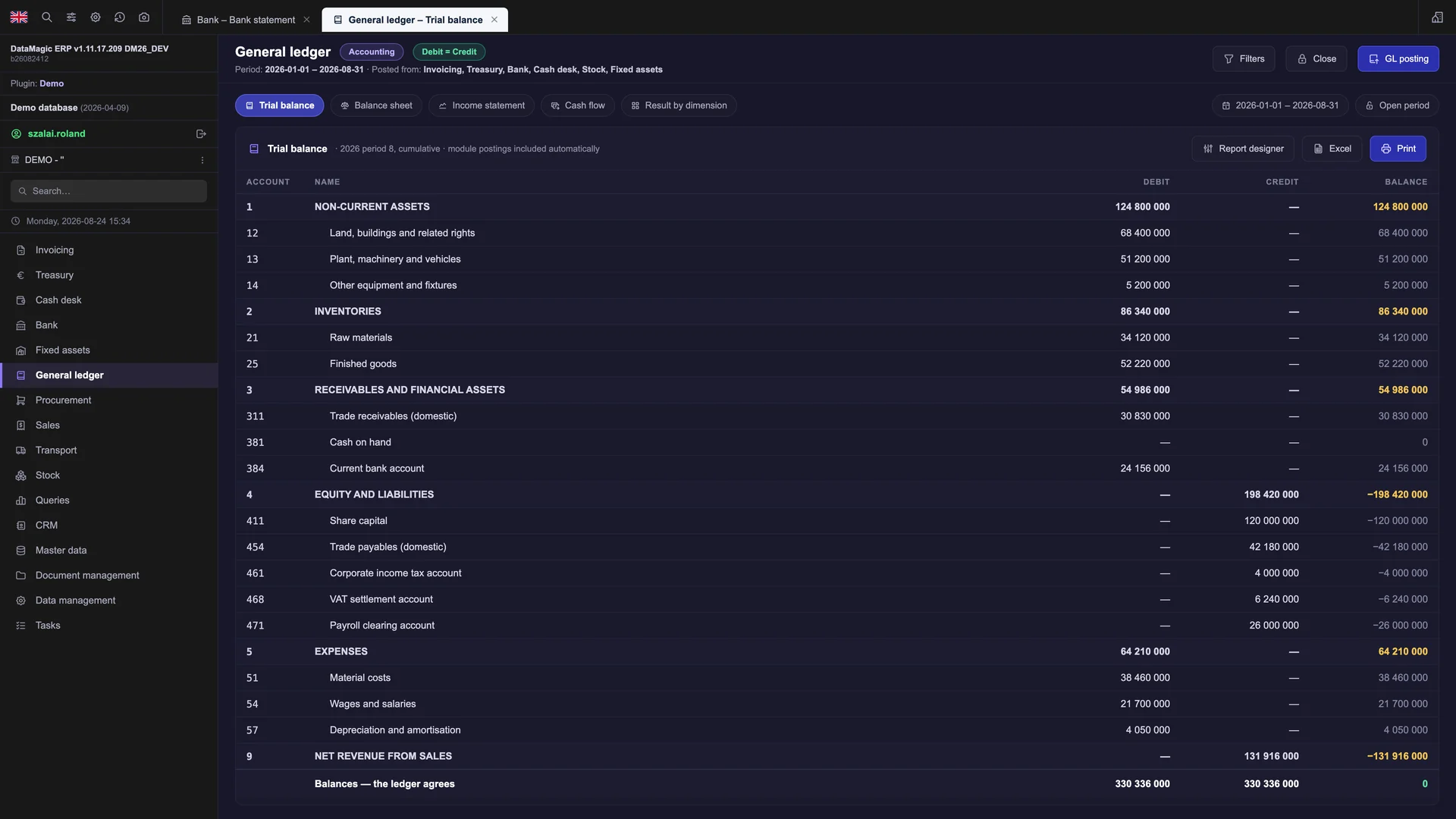
Movements from invoicing, finance, banking, cash, stock and fixed assets reach the general ledger posted by movement type. Manual bookkeeping remains available on the same screen.

General ledger – Trial balance
DataMagic FMS trial balance: breakdown by main account with debit, credit and balance columns
Reporting

More than accounting data in one view

A report can combine general-ledger, stock, sales, logistics and project data in the same view, in quantity and in value. Alongside statutory statements, management reports are built on the same surface.

Accruals

Accrual from saving the invoice to posting

An invoice covering several months – prepaid rent, annual insurance, a maintenance contract – is split by the system at the moment of saving across the actual period of validity, and then posted to the ledger month by month.

Corporate group

Parallel rule sets and consolidation

The same business event can be booked under local accounting rules and under IFRS, and member companies work on shared master data. The owner's report and the statutory financial statement come from the same data.

Fixed assets

An asset record from capitalisation to disposal

The whole life of an asset on one record: capitalisation, depreciation, maintenance, stocktaking, and finally sale or disposal. Depreciation is posted to the general ledger automatically.

Controlling

Dimensions: cost centre, project, owner

A dimension is a freely definable perspective along which documents and assets can be grouped. Eight dimension values can be assigned to one entry, so results can be reported from several angles.

Eight dimensions per entry

Cost centre, project, owner, business line or any perspective of your own, at document and fixed-asset level.

Dimensional profit and loss

Two-dimensional lists and cost reports, with the statement designer breaking results down by dimension.

Budget monitoring

Keeping to cost-centre and project budgets, with an alert to the owner on overrun.

Planning and forecasting

Plan, commitment and expected payment on one timeline

The system distributes cost across dimensions by rule, the plan is built on the same dimensions, and expected payments appear before the general-ledger posting.

Compliance

Regulatory connections and auditability

Regulatory tracking is daily and part of the system, not a separate localisation project. Every document and posting leaves a trace, so an audit can be documented.

Predictive cash flow

Expected balance from the data already booked

The forecast is built from incoming and outgoing payment schedules, open items, ageing and partner payment behaviour. The calculation runs on the same document set that bookkeeping works from, so the forecast needs no separate model.

Hybrid intelligence

Built-in AI in the financial processes

The AI capabilities are built on the permission, audit and document model of the framework, so recognised data reaches the right document directly. The solution runs on a provider-independent architecture and can be fitted to data protection expectations.

Document recognition

Incoming invoices and attachments processed with OCR, including handwriting. After recognition the system reconciles against order and goods receipt data, flags the difference, and the correction is learned for the next invoice.

AI assistant

A RAG-based assistant trained on the company's context and tuned to accounting and tax knowledge. A natural-language question becomes a query, and it knows which document is open.

Anomaly detection

Payment slippage, outlying costs and suspicious entry pairs flagged from the accounting data, before the close.

Workflow and permissions

Approval paths and field-level access

Process steps are assembled by a business user, with no development. The permission matrix controls down to a single data field, and logging records every step.

Integration

Payroll, banking and authorities over open interfaces

Payroll and HR modules are not part of the product; instead, a data connection can be built to any external payroll and HR system, and the payroll posting arrives as a finished general-ledger entry.

Let's get in touch

Request a demo, and let's look together at how DataMagic FMS fits your finance and accounting processes – from mid-sized business to corporate group.

Request a demo